

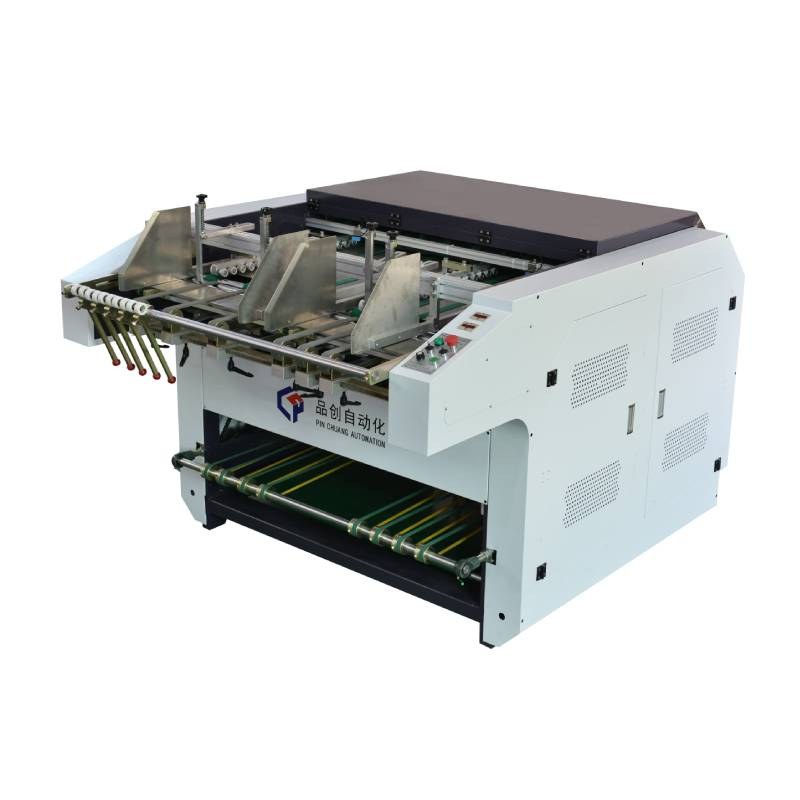
An automatic V grooving machine cuts a V-shaped channel into the greyboard along every fold line, so the board bends along the channel instead of cracking across a crease. It is the first operation that decides whether a rigid box will have sharp, clean edges or a cracked and whitened fold. Every downstream station can only preserve what the groove already provides — none of them can repair a bad one.
At Pinchuang, we have been manufacturing rigid box equipment in Dongguan since 2008, and grooving is the station where we see the largest gap between what buyers specify and what their boards actually need. This article explains what the machine does, how groove depth and angle interact with board thickness, what a bad groove looks like two stations later, and how to match grooving throughput to the rest of the line.
What an Automatic V Grooving Machine Does to a Rigid Box
Greyboard is a dense, brittle material. Fold it along a crease and the fibres on the outside of the bend are stretched until they tear, which shows as a crack or a whitened line under the wrap. Cut a V-shaped channel first, and the board bends through that channel with the material removed rather than torn.
The operation itself is straightforward. The board is fed into the machine, positioned to a reference, and one or more blades cut channels at a set angle to a set depth. On our platform the machine cuts up to 8 grooves on the PC-1200A configuration and up to 12 on the PC-1200S, with grooving angles selectable between 80–120° and 120–140°. Working width starts at 100 mm and runs to 1,200 mm or 950 mm depending on the model, and board thickness from 0.8 mm to 4.0 mm.
What matters is not the cut itself but its repeatability. An automatic V grooving machine holds depth to a quoted precision of ±0.05–0.1 mm and runs at 25–50 m/min. That precision figure is the reason automation replaced hand grooving on any serious line: a groove that varies by half a millimetre across a panel will fold visibly differently at one end than the other.
Groove Geometry: Depth, Angle and Board Thickness
Three settings interact, and changing one always means reconsidering the other two.
1. Depth
Depth is measured as how much of the board thickness is removed. Too shallow and there is not enough material removed to bend cleanly, so the board still cracks along the fold. Too deep and the remaining material is too thin to hold the box wall, and the fold line becomes a visible ridge through the wrap. The correct depth is a proportion of board thickness, not a fixed value, which is why a machine that lets you dial thickness and recalculates depth is worth more than one that does not.
2. Angle
Our machines cut at 80–120° or 120–140°, and the angle is normally matched to the fold the box needs. A box corner that turns through 90 degrees needs a groove that closes correctly when folded; an angle that is wrong will leave either an open channel visible at the corner or material that is forced to compress.
3. Board thickness and material
The same machine handles papercard from around 250 g and greyboard from 0.8 mm to 4.0 mm, but the settings are not transferable. A groove that works on 1 mm board will cut too deep on 0.8 mm and too shallow on 3 mm. This is the single most common source of frustrating quality complaints: a line that is re-set from a thin board to a thick one without revisiting the depth figure.
If there is one piece of advice worth taking from this article, it is to keep a written groove setting for every board thickness and product you run, and to check the first board of every size change against it. It takes a minute and prevents an entire shift of doubtful output.
What a Bad Groove Looks Like Downstream
Grooving faults rarely appear at the grooving machine. They appear at the forming station or in the customer's hands, and the symptoms point back to three settings.
| What you see | Cause | Where to fix it |
|---|---|---|
| Crack or white line along the fold | Groove too shallow for the board thickness | Groove depth |
| Visible ridge or shadow line through the wrap | Groove too deep, wall too thin to bridge it | Groove depth |
| Uneven fold across a wide panel | Depth drifting along the cut | Blade condition and machine precision |
| Corner that will not close tight | Groove angle does not match the fold | Groove angle setting |
| Box that folds well one day and not the next | Board batch variation between pallets | Incoming board check, not the machine |
The last row is the one buyers ignore. Grooving is sensitive to board density, and different batches of greyboard from the same supplier can behave differently at the same setting. A quick thickness and density check on arrival is worth more than any amount of adjustment during the run.
Where Grooving Sits in the Line
Grooving usually runs first, before gluing, wrapping and forming, because the board has to be cut while it is still bare. On a partially automated line it can also run as a separate batch operation: boards are grooved for a whole order, then fed to the rest of the process.
Throughput matching is where grooving causes the most confusion. Our grooving machines run at 25–50 m/min, which sounds enormous next to a forming station rated at 12–22 pcs/min. The two figures are not comparable: one is a linear feed speed and the other is a completed box rate. In practice a single grooving machine can keep several forming stations supplied, which is why grooving is often the least loaded machine in the plant and therefore the last one that needs replacing when capacity runs short.
The exception is a plant running very short runs with frequent board changes. There, the grooving machine's setup time rather than its speed becomes the constraint, and a second machine or a quicker tooling change can buy more capacity than anything downstream.
Two Grooving Configurations to Compare
Our grooving platform comes in two working widths. Both cut at the same angles, hold the same precision and run at the same speed; the difference is how much board they can take and how many grooves they cut in one pass.
| Parameter | PC-1200A | PC-1200S |
|---|---|---|
| Board width | 100–1200 mm | 100–950 mm |
| Max. number of grooves | 8 grooves | 12 grooves |
| Grooving speed | 25–50 m/min | 25–50 m/min |
| Precision | ±0.05–0.1 mm | ±0.05–0.1 mm |
| Material receiving | Standard delivery | Fully automatic receiving system |
The choice usually comes down to panel width and groove count. If your largest panel is under 950 mm and your constructions need many fold lines per sheet — multi-panel wraps, lids with several inner folds — the 12-groove configuration saves a pass. If you routinely handle boards wider than 950 mm, the wider machine is the only option, and the automatic receiving system on the S configuration is worth considering for any plant running unattended stretches.
For scale reference, Pinchuang builds this equipment in a 10,000 m² facility in Dongguan with more than 100 employees, and the machines ship to over 30 countries. We have been manufacturing rigid box equipment since 2008, and we exhibit at All in Print China, Printing South China, China Print, Drupa, SINO FOLDING CARTON and WEPACK.


Whatever the configuration, a grooving machine is only as good as its blades. Blade condition is the most common reason a setting that worked last month starts producing uneven folds this month, and it is the first thing to check before touching the depth figure. Looking at the applications we see most often is a good way to judge which fold constructions you will actually be asked to run.
Common Questions About V Grooving
Do I need V grooving for every rigid box?
Not for every box, but for every box with a visible folded edge. Small boxes with a soft wrap can sometimes be folded without grooving, and the result is acceptable when the fold is hidden inside the lid. Any box where the fold line will be seen by a customer should be grooved.
How deep should a V groove be?
Deep enough to let the board bend without cracking, shallow enough to leave material that holds the box wall. The correct figure is a proportion of board thickness rather than a fixed depth in millimetres, and it changes every time you switch board stock. Keep the figures written down per product and check the first board of each change.
How often do blades need changing?
It depends on board density and running hours rather than on calendar time. The signal is a fold that has started to vary across the panel, or a groove that needs a deeper setting than before to fold cleanly. Replace on that signal rather than on a fixed schedule.
Can one machine handle both thin papercard and thick greyboard?
Yes. Our grooving platform covers papercard from around 250 g and greyboard from 0.8 mm to 4.0 mm on the same machine. What it cannot do is switch between them without a setting change, so treat each thickness as a separate setup rather than assuming the last setting still applies.
Send Pinchuang a sheet of your greyboard with the fold lines marked, along with your largest panel size and your smallest box. We will tell you which automatic V grooving machine covers the range, and what groove depth your board actually needs.
Send us a marked board Compare both grooving models