

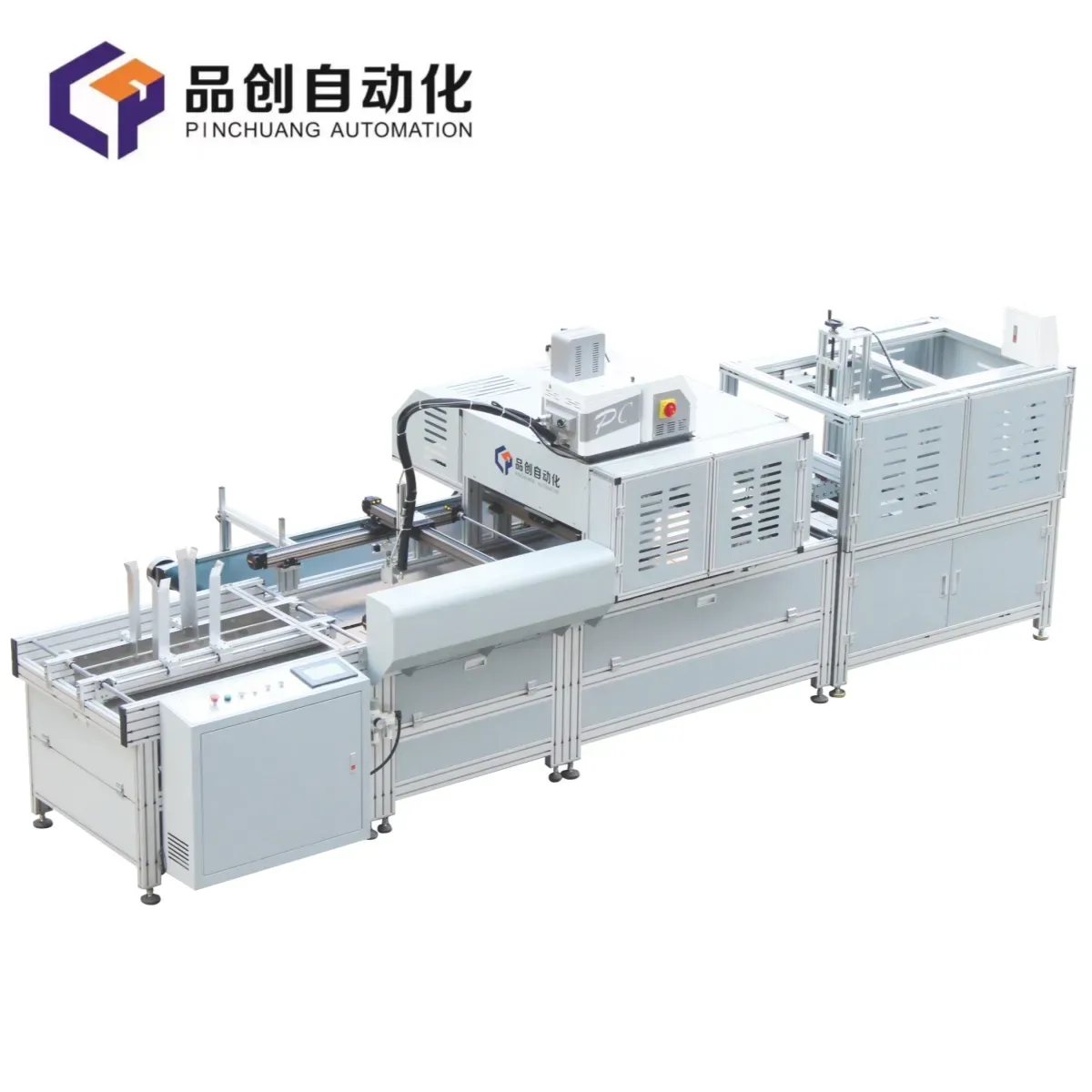
A fully automatic rigid box making machine is one that carries the panel through gluing, wrapping, corner pasting and forming without an operator handling it between stations. The word "fully" refers to the material flow, not to the headcount: the machine still needs someone to feed it, set it and check it. Everything else in this article follows from that distinction.
At Pinchuang, we have been manufacturing rigid box equipment in Dongguan since 2008, and the most common misunderstanding we meet is that "fully automatic" means a machine you can leave alone. This guide defines the levels of automation in plain terms, sets out what full automation demands from your building and your material supply, and says where a fully automatic machine is simply more machine than an order book justifies.
Defining a Fully Automatic Rigid Box Making Machine Without Sales Talk
Suppliers use "automatic" loosely, so it is worth pinning down what the word is doing. Three things separate a fully automatic machine from a semi-automatic arrangement of the same stations.
- Continuous transfer. The wrapped panel moves from station to station inside the machine. No one lifts it, and no one re-registers it by eye.
- Automatic feeds. Board and wrap are fed from stacks rather than placed one piece at a time. Board stacks on production models commonly run to 1,000 mm high, which is what makes long unattended stretches possible.
- A single control reference. Size, glue film and forming pressure are set once and held by the controls, rather than adjusted at each station during the run.
If any of those three is missing, what you have is a semi-automatic line. That is not a criticism — a semi-automatic line is often the right answer for a mixed order book. It simply means the labour and consistency profile is different, and it should be priced and planned accordingly.
The same vocabulary matters when you compare quotations. A machine described as a rigid box making machine may be anything from a single forming station to a complete line, and the specification sheet is the only place that distinction is honest.
Four Levels of Automation and What Each One Costs You
It helps to place your factory on a four-step ladder rather than treating automatic and manual as two boxes. Each step up trades flexibility for repeatability.
| Level | What the operator does | Strength | Limitation |
|---|---|---|---|
| Manual bench | Wraps, folds and forms by hand | Any shape, any quantity | Consistency depends on the person |
| Semi-automatic | Moves product between separate modules | Good glue and wrap quality at moderate cost | Handling between modules still shifts the wrap |
| Fully automatic | Feeds, sets and inspects | Repeatable output across a shift | Changeover becomes the bottleneck |
| Full line | Supervises and reacts | Volume production with a stable box range | Needs real volume to stay loaded |
Read the table from the bottom up when you are planning. The question is not "how much automation can I afford", but "how much repetition does my order book actually contain". Automation converts repetition into margin; it does not create repetition where none exists.
What Full Automation Requires From Your Factory
A fully automatic machine changes what the building has to provide. Before you compare models, check these five points, because each one can add cost after the machine is on the water.
- Floor space in a straight run. A rigid box line is long. Machine dimensions on our rigid box platform run to roughly 8,200 mm in length, and you need clearance at both ends for the board stack and for output. A line that fits on paper but not with a pallet at each end will be re-arranged twice.
- Power and compressed air. A typical rigid box machine draws on the order of 15 kW at 380 V three-phase, plus a separate heating circuit, and expects 0.6–0.8 MPa of clean, dry air. Air quality is underestimated: water in the line shows up as inconsistent glue film.
- Board supply in the right condition. A machine feeds from stacks, so board has to arrive flat and at consistent thickness. Warped greyboard will jam a feeder that works perfectly on good board, and no adjustment fixes a bad pallet.
- Tooling for each size. Forming moulds and setting jigs are size-specific. A plant running six standard sizes needs six sets ready, otherwise every order change becomes a fabrication job.
- A person who owns the setting. One operator per line, accountable for glue checks, first-box approval and changeover, is worth more than three people with no owner.
The stations that feed a forming unit are usually where the money is won or lost. A paper gluing machine that holds an even film and a V grooving machine that cuts to a repeatable depth do more for box quality than a faster forming station downstream.
Where a Fully Automatic Machine Is Overkill
We turn down as many fully automatic enquiries as we accept, usually for one of four reasons.
- Every order is a different shape. If changeover is longer than the run, the machine spends its life being set up. A bench or a semi-automatic module will out-produce it on genuinely mixed work.
- Volume is low and stable. A line that runs two days a month cannot pay back on the consistency it provides. At that volume, consistency is better bought by training than by capital.
- Board quality is out of control. Automation amplifies whatever the material does. If incoming board varies, the machine will report that variance faster and louder than a bench ever did.
- Nobody is available to run it. A fully automatic machine needs a trained setter. Buying one without planning that person is the most expensive way to have a machine stand still.
Which level of automation fits is really a question about how much of your order book repeats itself. Answer that first and the equipment list usually writes itself.
Three Configurations to Compare Side by Side
Pinchuang builds rigid box equipment in a 10,000 m² facility in Dongguan with more than 100 employees, and the machines ship to over 30 countries. We exhibit at All in Print China, Printing South China, China Print, Drupa, SINO FOLDING CARTON and WEPACK, which is where most buyers first see the difference between a single automatic machine and a full double-station line in person.
On the rigid box platform, three configurations cover most of what enquiries actually need: the double-station PC-8040A for plants moving toward line production, the high-speed PC-5040A, and the PC-5010D that runs rigid boxes and hard book covers on one frame.


If your product mix is wide rather than deep, it is often more sensible to add a corner pasting machine or a visual positioning machine to an existing setup before committing to a full line. Adding one station at the bottleneck usually buys more capacity than replacing everything at once.
Common Questions About Full Automation
Does a fully automatic machine run without an operator?
No. It runs without an operator handling the product, which is a different claim. Someone still loads board and wrap, checks glue, approves the first box after a changeover and watches for jams. Treat the operator as a setter rather than a wrapper when you plan the shift.
How much floor space does a full line need?
Plan around the machine outline plus clearance at both ends. On our rigid box platform the machine itself is roughly 8.2 m long, and you should assume you need somewhere to put a board stack in front of it and a pallet behind it. Laying the line out at full scale on the floor before ordering is time well spent.
What power supply does it need?
A typical rigid box machine on this platform runs about 15 kW at 380 V three-phase with a separate heating circuit, and needs air at 0.6–0.8 MPa. Confirm both against your building before the machine is shipped, because upgrading a supply is far easier while the floor is still empty.
Can I upgrade from semi-automatic to fully automatic later?
Often yes, and it is usually the cheaper route. Many plants start with a gluing and forming pair and add corner pasting, V-grooving or positioning as each becomes the bottleneck. The catch is that stations added later must be matched to the ones already in place, so it pays to buy the first machine with the final line in mind.
Send Pinchuang your box range, monthly volume and a floor plan sketch. We will tell you which fully automatic rigid box making machine level your order book actually justifies, and which stations can wait until the volume arrives.
Ask us to size the line See every model we build